
Last updated November 14, 2026
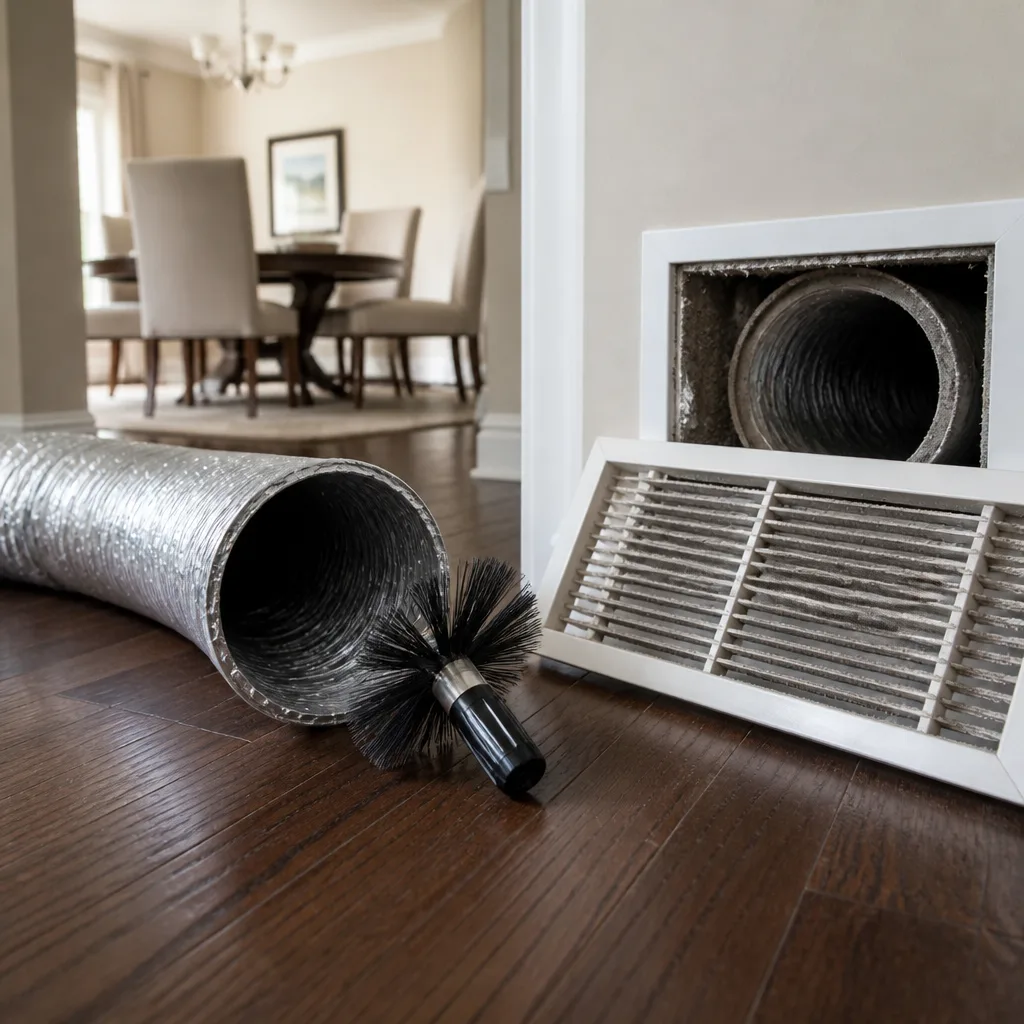 Whole-home duct cleaning
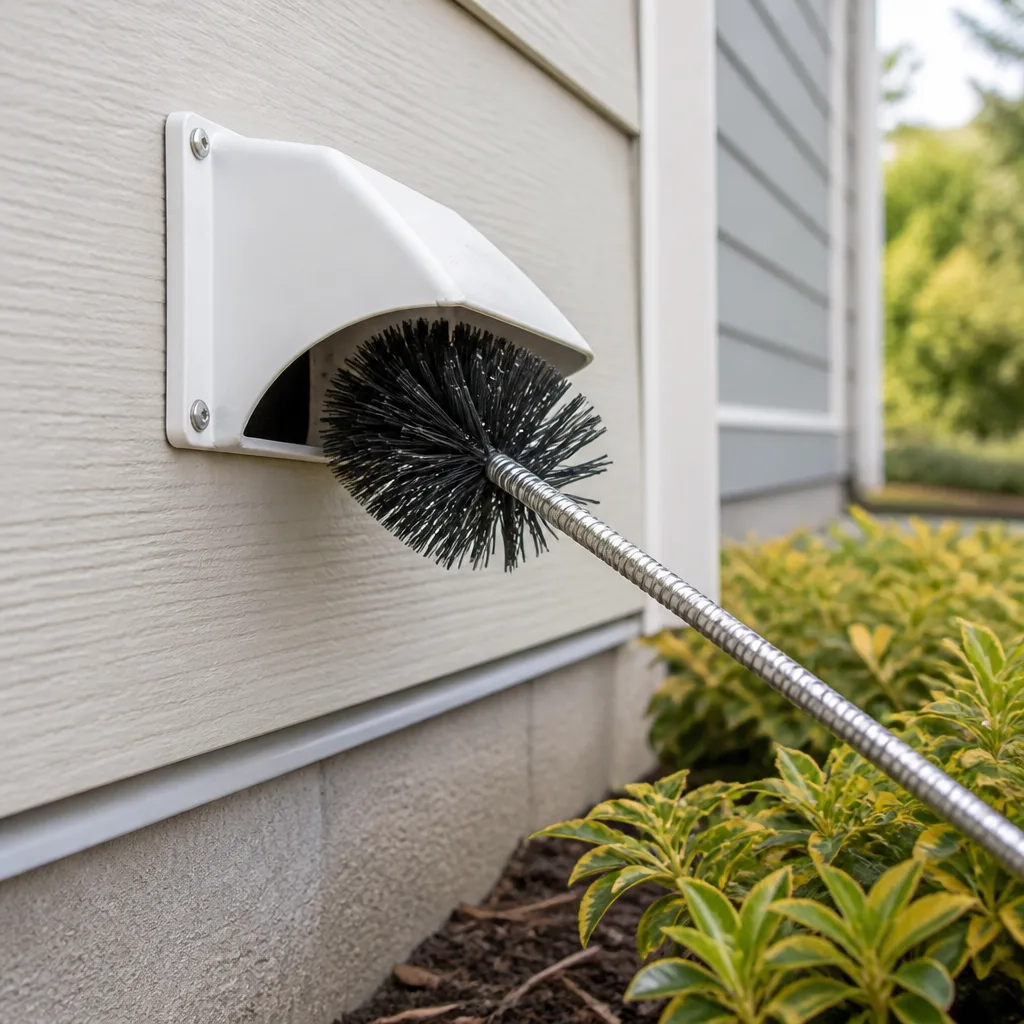 Dryer vent cleaning
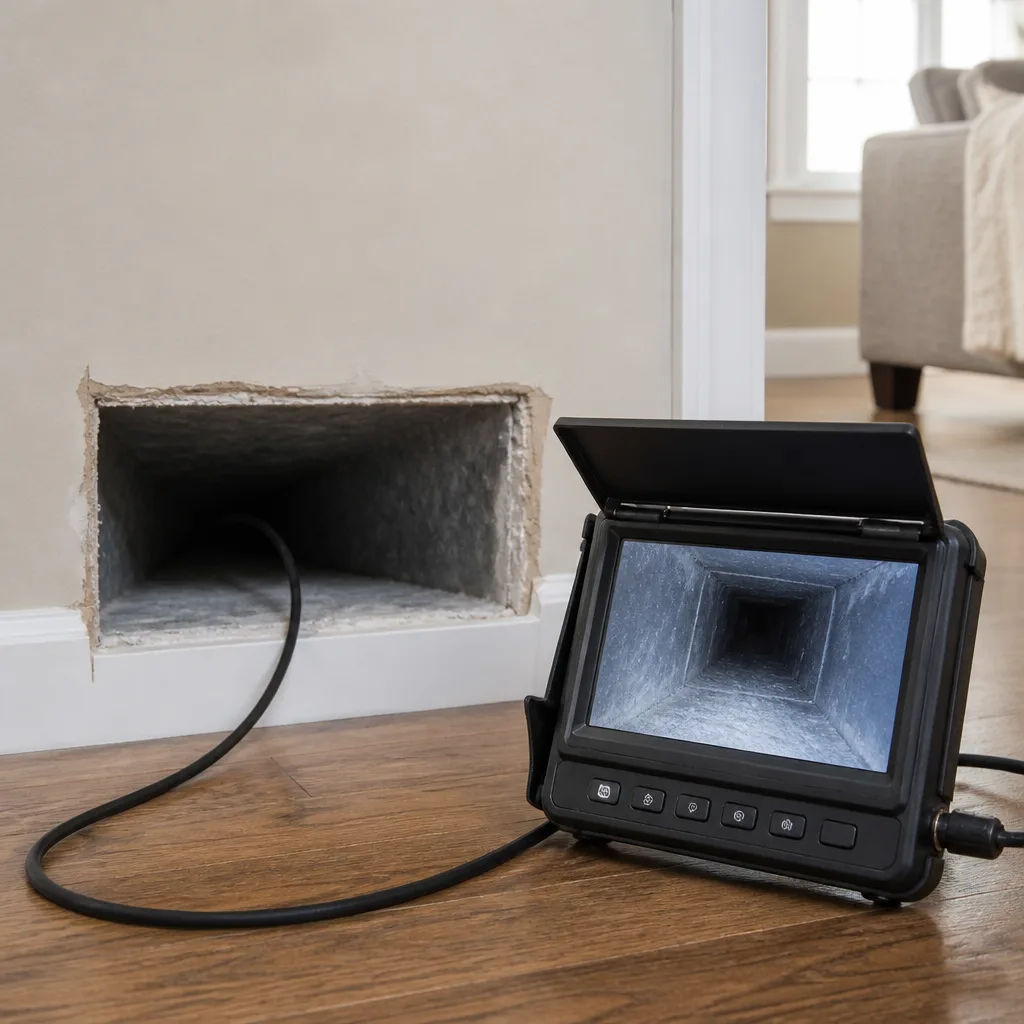 Camera inspection
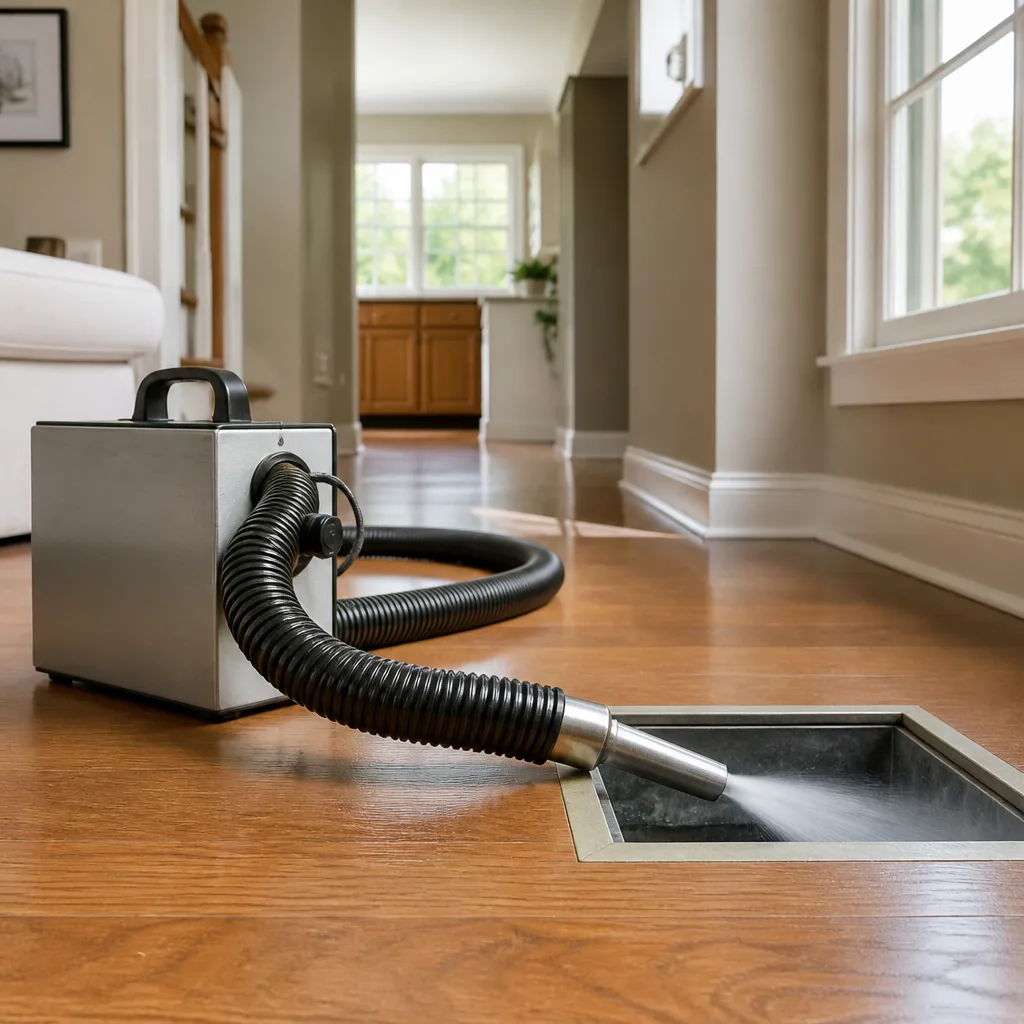 Sanitizing & deodorizing
Whole-system duct and dryer vent check with before-and-after photos - you see exactly what came out of your vents
That "$99 whole-house special" is a bait ad - the real number appears once they are in your hallway, or the "clean" is a shop-vac at the register. We photograph the inside of your ducts before and after instead.
Air Duct Cleaning Troubleshooting in San Mateo: Common Problems and How to Fix Them
If a room still feels stuffy two weeks after a duct cleaning, the ducts probably weren’t the problem in the first place. That’s the part most homeowners get handed the wrong answer on. They call for a cleaning, a crew runs a brush and a vacuum through the system, the invoice gets paid, and nothing changes in the back bedroom. The dust came back. The air still feels flat. The instinct is to blame the cleaning, or to assume the ducts need cleaning again. Most of the time it’s neither. A duct-cleaning visit fixes a specific problem, and a surprising number of what people call “dirty duct” symptoms in San Mateo are actually airflow symptoms or equipment problems sitting upstream of the ducts themselves. This guide walks you through how to diagnose the difference before you spend money, which complaints genuinely warrant a callback, and when the answer turns out to be repair or replacement rather than another cleaning.
Quick Answer
If cleaning didn’t fix the problem, the likely cause is one of three things: a duct system that was dirty on top of a mechanical failure (weak blower, crushed flex duct, wrong static pressure), a duct run that’s damaged or blocked rather than dusty, or a contamination problem upstream of the section that was cleaned. The way to tell is to separate the symptoms – dust and odor point toward cleanliness, while weak airflow and uneven room temperatures point toward the system itself. A tissue test and a register thermometer will tell you which category you’re in within minutes.
Styles & brands we work with
- Whole-home duct cleaning
- Dryer vent cleaning
- Camera inspection
- Sanitizing & deodorizing
Table of Contents
- Is It Dirty Ducts or an Airflow Problem? How to Tell
- The Two Tests to Run Before You Call Anyone
- Why San Mateo’s Older Slab-on-Grade Homes Fail Differently
- What a Negative-Pressure Reading Tells You About the Job
- The Three Post-Cleaning Complaints That Warrant a Callback
- When Cleaning Becomes a Repair Job
- When to Escalate From Repair to Replacement
- Common Mistakes to Avoid
- When to Call a Professional
Is It Dirty Ducts or an Airflow Problem? How to Tell
The single most useful thing you can do is stop treating every symptom as the same problem. Duct problems in San Mateo fall into two families, and they have almost nothing in common in terms of cause or fix.
Dirty-duct symptoms are about what’s in the air. Dusty registers that darken again within days of wiping them. A musty or stale smell that gets stronger when the system kicks on. Visible dust plumes at a supply vent when the fan starts. Allergy symptoms that ease when you leave the house and return when you come back. These point to accumulated debris, biological growth, or contamination inside the ducts, and a proper cleaning using rotary brush agitation and HEPA-filtered negative air is the right answer.
Airflow symptoms are about how much air moves, not what’s in it. A room that never quite warms up in winter or cools down in summer. A supply register you can barely feel with your hand. Uneven temperatures between rooms that share a thermostat. A system that seems to run constantly without satisfying the thermostat. Dust on the furniture that reappears no matter how often you clean. These point upstream – the blower, the duct layout, static pressure, or a damaged run.
The two types overlap often enough that homeowners assume they’re one thing. In our experience, a large share of the “cleaning didn’t work” calls we get in San Mateo are airflow symptoms wearing a dirty-duct disguise. Cleaning a system with a crushed flex duct in a San Mateo attic or a blower that’s lost output is like washing a car with a bad fuel pump. The wash is fine. The car still won’t drive.
Quick symptom table
- Dusty registers that darken again fast: dirty-duct symptom. Cleaning is likely the right first step.
- Musty smell that strengthens with the fan: possible contamination or biological growth. Cleaning plus an inspection upstream of the cleaning zone.
- Weak supply at one or more registers: airflow symptom. Get the system diagnosed before cleaning.
- Uneven room temperatures: airflow symptom. Often a duct design or blockage issue, not a cleanliness issue.
- Rattling or tapping after cleaning: dislodged insulation lining. Callback.
- Worse airflow after cleaning: blockage pushed rather than removed. Callback.
The Two Tests to Run Before You Call Anyone
You don’t need tools to separate the two categories. You need five minutes and two household items.
Test 1: The tissue test
- Turn the thermostat to fan-only mode so the blower runs without heating or cooling.
- Hold a single-ply tissue flat against a supply register with the airflow coming through it.
- Watch how far the tissue lifts. On a healthy system it should stand nearly horizontal. On a weak run it will droop or fall flat.
- Repeat at every supply register in the house. Compare the strength register to register.
If one or two registers barely move tissue while others push it hard, you have a distribution problem, not a cleanliness problem. That points to a duct size issue, a crushed or disconnected run, or a damper that’s been closed and forgotten. If every register is weak, the problem may be the blower, the filter, or the return side. If every register is strong and the house still feels stuffy, the system is moving air but not conditioning or exchanging it well – a different conversation entirely.
Test 2: The register thermometer reading
- Run the system in cooling for fifteen minutes on a day warm enough to call for it.
- Point a basic infrared thermometer (or an instant-read kitchen thermometer held close to the register face) at the supply air stream.
- Write down the supply temperature at each register.
- Note the return air temperature at the main return grille.
A spread of roughly 15 to 20 degrees Fahrenheit between return and supply is the normal operating range on most residential systems. A register that reads close to return temperature is barely delivering conditioned air. A register that reads far colder than the rest points to an airflow issue specific to that run. A system that reads out of range at every register is a broader system problem, and no amount of duct cleaning will move that number.
Write down both sets of results on a sheet of paper with the date. If you eventually call for air duct cleaning, those numbers give the technician something real to work from instead of a feeling.
Why San Mateo’s Older Slab-on-Grade Homes Fail Differently
San Mateo has a substantial stock of homes built in the 1950s and 1960s, and a good many of them, including the Eichler-style homes that define sections of the mid-Peninsula, sit on slab foundations with no crawlspace. That construction choice has consequences for the duct system that almost no generalist cleaning crew will mention to you.
When ducts run under a slab rather than through an attic or a crawlspace, they’re surrounded by concrete and, over time, moisture. These systems are typically galvanized sheet metal, sometimes wrapped or coated, and the failure pattern is different from a flex-duct attic system. Instead of tearing or kinking, the metal corrodes from the inside out. Moisture that collects in the low points of a slab run, condensation from the cooling coil, poor drainage around the duct penetration, or years of small leaks slowly eat through the galvanized surface. The first sign is often rust-colored staining at a register face or a metallic, dusty smell when the system starts.
Standard duct cleaning cannot fix this. A rotary brush will agitate the interior, but if the metal is already perforated or scaled with rust, the cleaning dislodges material into the air stream and exposes the damage underneath. Worse, a slab-embedded duct is very difficult to reach, very difficult to replace without cutting concrete, and very easy for a cleaning-only company to declare “clean” and move on from. A specialist should flag slab-embedded runs during the inspection and tell you plainly whether cleaning is appropriate or whether the run needs to be bypassed or rerouted above the slab.
Homes in San Mateo with attic-routed ductwork have a different but equally local failure pattern. Flex duct in a sealed attic gets hot, and the plastic inner liner can degrade over time, shedding material into the air stream. A cleaning that agitates this liner without inspecting it first can make the problem worse. In both cases, the pattern is the same: diagnosis before agitation.
What a Negative-Pressure Reading Tells You About the Job
Here’s the question that separates a real duct-cleaning operation from a vacuum-and-a-hose operation: what negative pressure was the system held at during cleaning?
When a duct system is cleaned, the entire zone being cleaned should be placed under negative pressure relative to the room it serves. Negative pressure means the air pressure inside the ducts is lower than the air pressure in the house. The reason it matters is that every time a technician agitates debris loose from the duct interior, that debris has to go somewhere. Under proper negative pressure, the loosened material is drawn into the HEPA-filtered collection unit and never enters the room. Without it, dislodged debris gets pushed into the living space and settles on surfaces you then have to clean up.
A Nikro HEPA-filtered negative-air setup is designed to hold exactly this condition. During a proper cleaning, the technician should be able to tell you what the reading was, how they maintained it across the length of the job, and in which zone. If the technician can’t give you a number, a zone, or a method, the equipment may have been running as a glorified shop vacuum with no measurement at all. That matters more than the brand name on the box.
The same principle applies with Abatement Technologies equipment on contaminated or compromised systems. When there’s biological growth, construction debris, or pest material inside the ducts, the negative pressure has to be established and held before agitation begins, not after. A crew that starts brushing and then hooks up the HEPA unit has already pushed debris into the room.
Ask three questions of any crew before you hire them:
- What negative pressure are you holding the system at, and can I see the reading?
- Are you using a rotary brush system like a Rotobrush, or a whip and a vacuum?
- What happens to the debris that comes off the walls – where does it go?
If all three answers are clear and specific, you’re talking to a specialist. If any of the three turns vague, keep asking. If a quote is dramatically lower than the rest, this is usually where the difference shows up. Ask specifically about equipment and the negative-pressure reading before you accept it.
The Three Post-Cleaning Complaints That Warrant a Callback
Some post-cleaning complaints are noise. Some are real. Here are the three that always justify calling the company back, and why.
1. Persistent musty smell
If a musty smell is stronger after cleaning than before, or no better at all a week later, the likely cause is biological growth upstream of the cleaning zone. Coils, plenum, drain pans, and the interior of an air handler are all common locations for mold and mildew, and none of them are inside the ductwork itself. A cleaning that stops at the register face and works backward only through the ducts will leave those surfaces untouched. A good company will come back, inspect the air handler, coil, and drain pan, and tell you honestly whether the growth is inside the cleaning scope or outside it. In a mild-winter climate like San Mateo’s, condensation on a cooling coil is the usual starting point.
2. Rattling or tapping after the job
A rattle that starts right after cleaning is usually not the duct itself – it’s the internal insulation lining. Some flex duct and some internally lined sheet metal ducts have a foil or fiberglass liner glued to the inside surface. A rotary brush that’s spun too aggressively can lift the liner off the wall of the duct. When the blower runs, the loose liner flaps and taps. This is a repair issue, not a cleaning issue, and it does not resolve on its own. Call the company back and expect them to inspect the affected run and either reattach or replace the lining. This is where a company that offers duct repair alongside cleaning earns its keep; a cleaning-only outfit will often tell you the rattle is unrelated.
3. Worse airflow after cleaning
If the system moved more air before the cleaning than after, the most likely cause is a blockage that was pushed rather than removed. Loose debris, a dislodged chunk of liner, or a damaged damper can end up jammed against a fitting or a coil face. The result is a sudden drop in airflow at the registers on that branch. Do the tissue test again and compare to what you wrote down before the cleaning. If airflow is measurably worse, call back and describe exactly what changed, at which registers, and when.
Any of the three, plus anything that feels unsafe (a burning smell, a whistling sound under the floor, visible debris blowing into a room), is worth a same-day call. Call (866) 894-2153. We answer 24/7. Fast dispatch from 7am to 7pm, Sunday through Friday.
When Cleaning Becomes a Repair Job
Some of what looks like “dirty ducts” is really damaged ductwork, and cleaning around it just makes the damage visible. The transition from cleaning to repair is where most cleaning-only companies leave the customer stranded, and it’s the moment to figure out whether the crew you hired can actually close the loop.
The triggers that should shift a job from cleaning to repair:
- Visible kinks or crushing in flex duct. Flex duct should run in smooth, generous curves. A kink that pinches the cross-section reduces airflow to a fraction of what that run was designed for. Cleaning a kinked run doesn’t fix the airflow problem because the kink is a physical fact, not a contamination one.
- Disconnected or slipped joints. A flex duct that has slipped off a plenum collar, or a hard duct joint that’s separated, dumps conditioned air into the attic or crawlspace and pulls dust straight into the system. Look for dust trails near joints in the attic or crawlspace, if you have one. On a slab-on-grade home, listen for air leaks under the floor near the plenum.
- Visible rust pitting on galvanized sheet metal. If the duct surface is pitted, flaking, or perforated, cleaning pushes material across the surface and can open small holes into larger ones. A section of duct that’s corroded from the inside should be replaced, not cleaned.
- Torn or failing internal liner. If the inside of the duct is shedding its lining, cleaning amplifies the problem. The liner has to be addressed first.
- Compromised duct that needs containment. When contamination is severe, working in a controlled, negative-pressure environment (which is what Abatement Technologies equipment is built for) is the right call before any surface is disturbed.
The right answer for a San Mateo home with corrosion pitting on a slab-embedded galvanized duct is often to bypass that run above the slab rather than attempt a cleaning. For a house with a kinked attic flex run, the answer is to replace the run and re-check the airflow at the register. In either case, the cleaning and the repair belong under one scope of work, not divided between two contractors who never speak to each other.
If you’re comparing companies, ask a simple question: can they repair what they find, or only clean around it? A company that has to call someone else in for the repair will usually recommend more cleaning. A specialist that can do both will diagnose honestly, because the answer isn’t always “clean it again.”
When to Escalate From Repair to Replacement
Repair isn’t always the answer either. Some duct systems have aged past the point where patching makes sense, and a homeowner who keeps cleaning one of these will keep paying for a fix that never sticks. The visual indicators that push a system from repair to replacement:
- Visible flex duct kinks that keep reappearing after repair. If a run was straightened and re-supported and it’s back to a kink within a season, the run’s layout is the problem, not the section of duct.
- Insulation R-value below current code. Duct insulation that’s below what current code calls for in this climate zone is quietly leaking conditioned air year-round. Replacing the run brings it up to current standard and often pays back in airflow and efficiency.
- Galvanized sheet metal with visible rust pitting. Once the metal surface is pitted, it can’t be cleaned back to a sound condition. Replace the section.
- Multiple disconnected joints along one branch. One connection can be repaired. A branch with several slipped connections needs to be re-run.
- Crushed duct in a chase or under a slab. If the run is physically crushed and not accessible without major work, replacing instead of chasing the crush is the honest call.
- Interior lining shedding across multiple sections. One compromised section can be replaced. A system where the lining is failing in several places is a full re-run of those branches.
For homeowners in San Mateo, this last point comes up more than you’d expect in older homes where the ductwork has never been updated. The ductwork isn’t failing because it’s old – it’s failing because it was installed to a code that’s been superseded, and the geometry no longer matches what the system needs. That’s a replacement conversation, not a cleaning one.
Common Mistakes to Avoid
- Booking a cleaning before you’ve done the tissue test. Two minutes and a tissue will tell you whether you’re dealing with a dirt problem or an airflow problem. Skip this step and you’ll pay for cleaning that doesn’t address the thing you actually called about.
- Believing a quote built around a low teaser price. In San Mateo, a whole-system cleaning that starts low and then adds per-vent upcharges once the technician is on site is the classic pattern to watch for. A written, flat-price-per-system estimate agreed before work starts is the only structure that protects you.
- Assuming your HVAC contractor is also a duct specialist. General HVAC contractors are set up for equipment service calls. Duct cleaning requires rotary brush systems, HEPA negative-air units, and the containment discipline to run them properly. Ask what equipment they’ll use before you book.
- Letting a crew clean without establishing negative pressure first. The first action on the job should be setting up containment and holding the system at negative pressure. If the crew starts agitating duct surfaces before that happens, debris is going into your rooms.
- Writing the complaint off after a callback. If the company came back and the airflow is still measurably worse, or the smell is still there, that’s your signal to bring in a second opinion. A post-cleaning problem that doesn’t resolve on the first callback is usually a repair issue, not a return-visit issue.
- Re-cleaning a system with slab-embedded duct without inspecting it first. In San Mateo’s older slab-on-grade homes, a corroded under-slab run can be years past the point where cleaning is safe. Get it inspected before the brush goes in.
- Ignoring the dryer vent on the same visit. A dryer vent cleaning removes the lint that’s the leading cause of residential dryer fires, and it’s a quick add-on while the equipment is already set up for the duct side. Skip it and you’ll be calling someone back later.
When to Call a Professional
Bring in a specialist when the symptoms cross into territory you can’t safely diagnose on your own. That includes: a persistent musty smell you can’t trace, airflow that gets measurably worse after any service, a rattle that starts after a cleaning, visible rust pitting on a duct surface, or an under-slab duct run in a San Mateo home you’re not sure has ever been inspected. It also includes the routine trigger for a whole-system visit – dusty registers, an unfinished system walkthrough, and no clear picture of what the previous owner did. If you’re in one of these situations and you want a straight read, Duct Cleaning San Mateo offers free estimates in San Mateo – call (866) 894-2153.
Our technicians have up to 10 years of experience and use Rotobrush rotary cleaning and Nikro HEPA containment so that the answer you get is based on what’s actually in the system, not on what a portable shop vacuum can reach.
See the difference
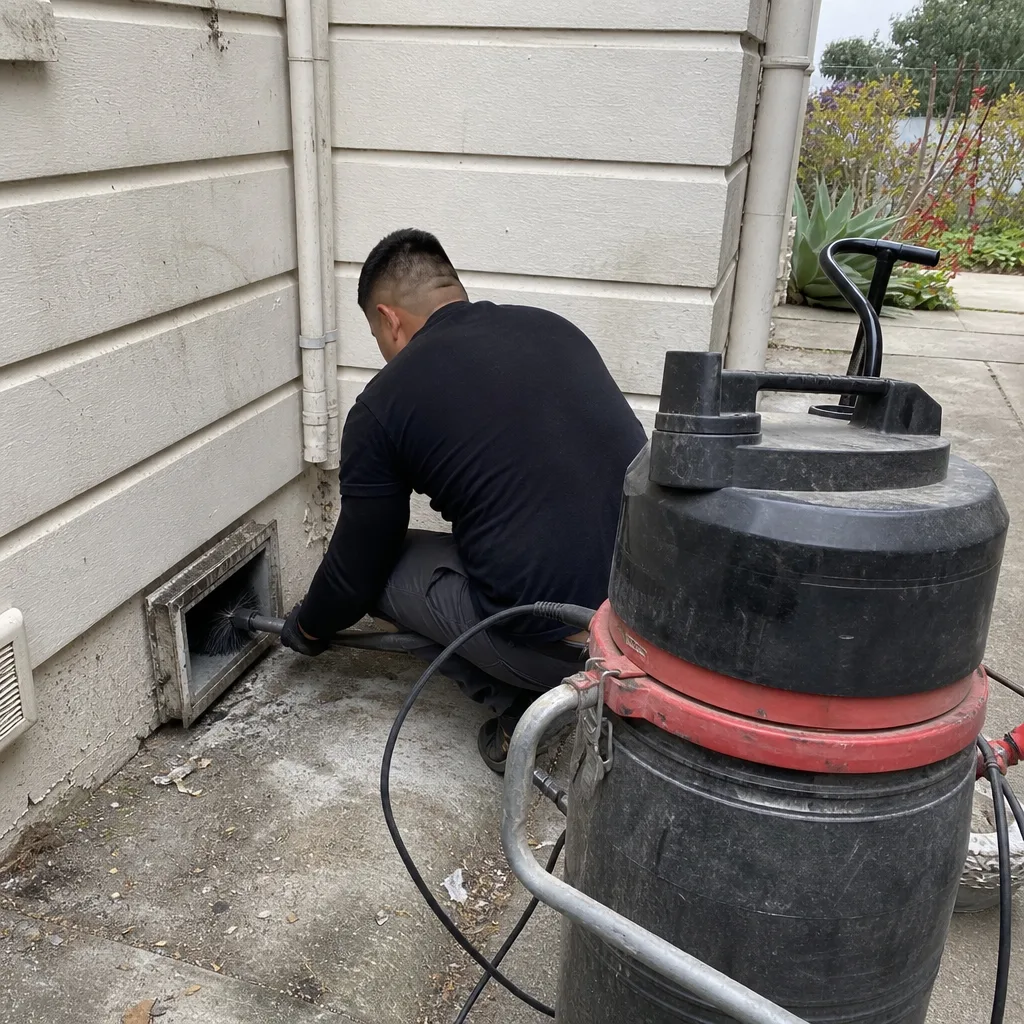 Before
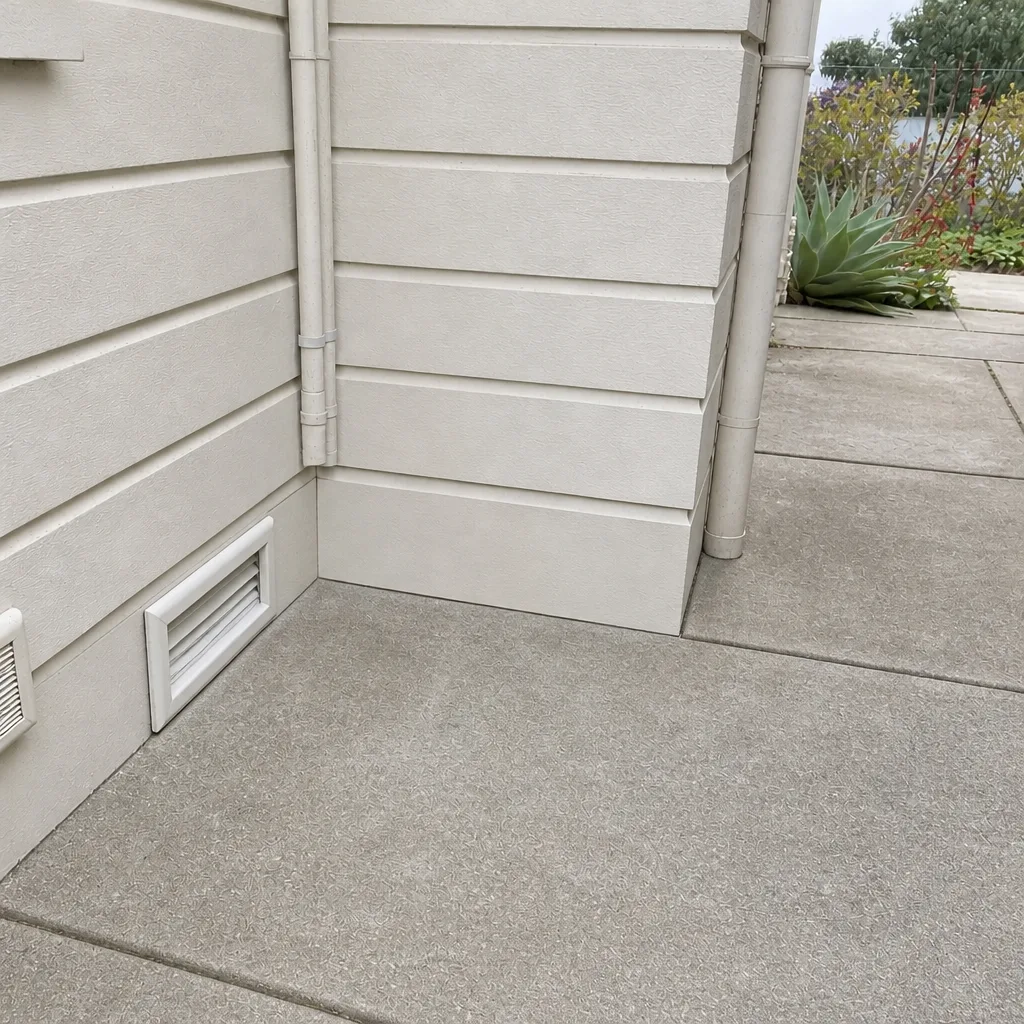 After
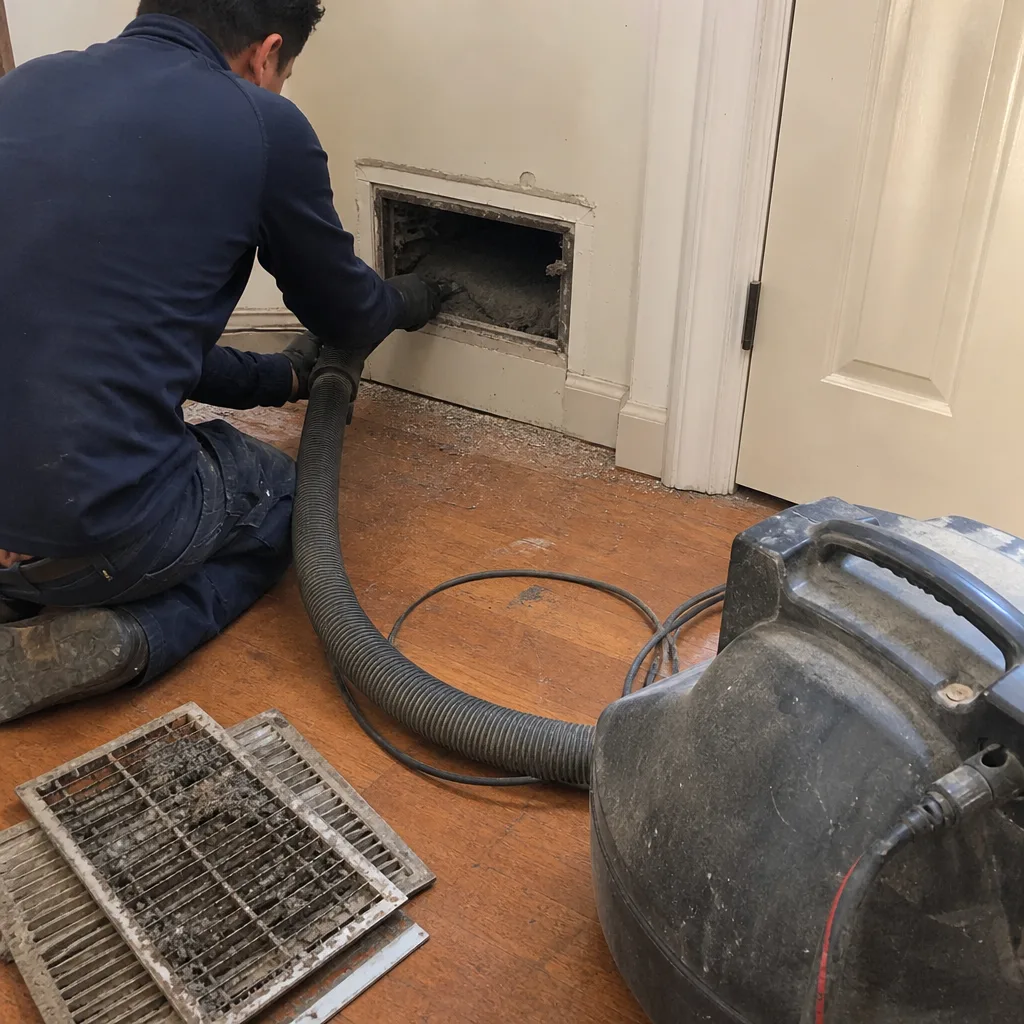 Before
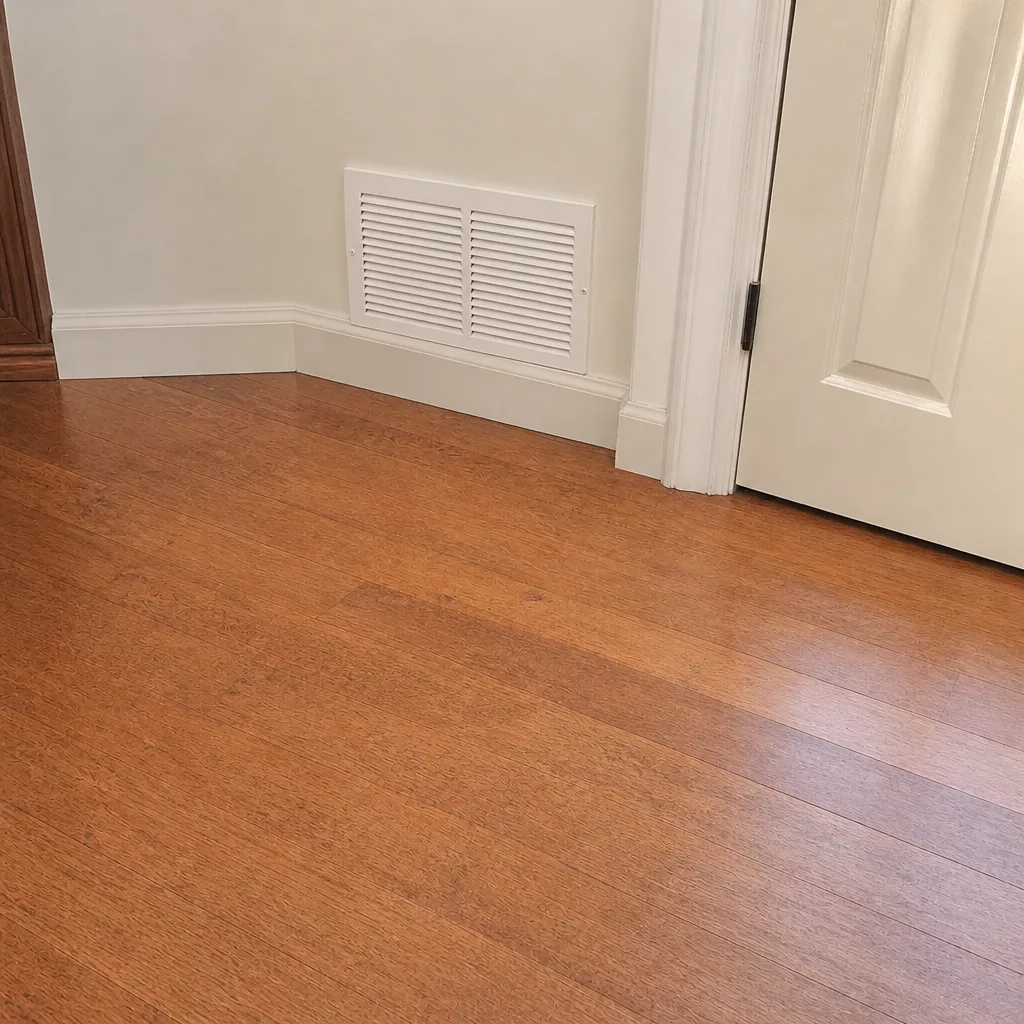 After
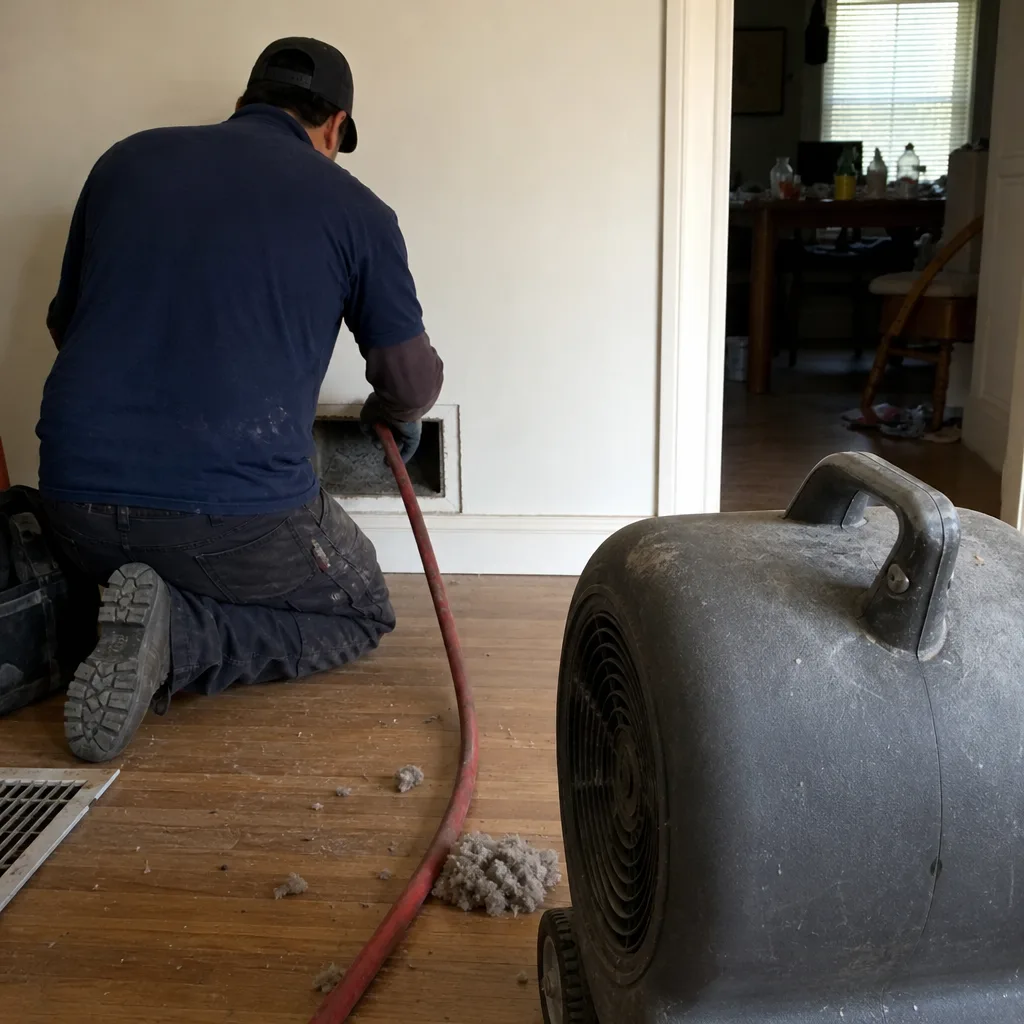 Before
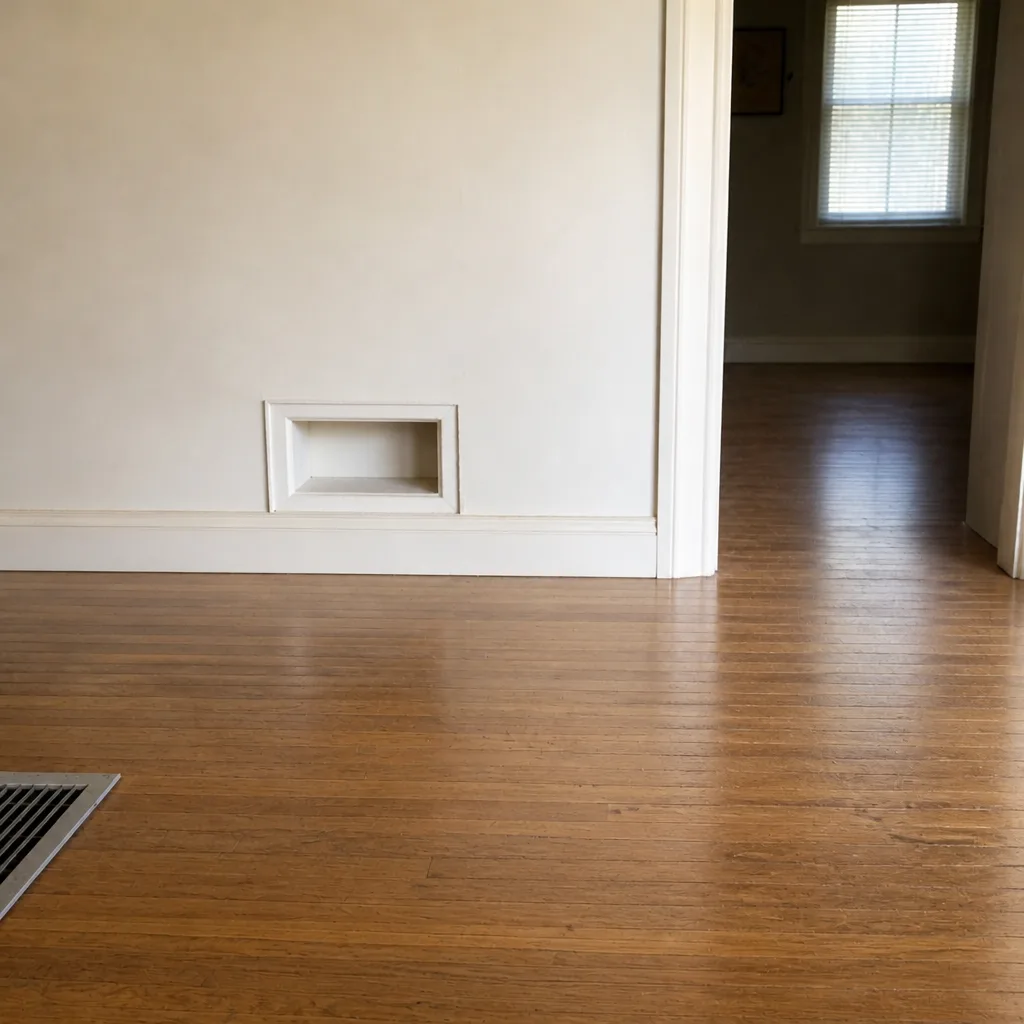 After
Frequently Asked Questions
Because the problem wasn’t in the ducts. Dusty registers and a musty smell respond well to a proper whole-system cleaning with rotor brush agitation and HEPA negative air. Weak airflow, uneven room temperatures, and stuffy rooms that persist after cleaning are almost always a mechanical or duct-damage issue upstream of the cleaning zone – a crushed flex run, a failing blower, or a corroded under-slab duct that a standard cleaning can’t reach. Run the tissue test and the register thermometer reading before your next call. Call (866) 894-2153 for an exact quote – estimates are free.
Whole-system duct cleaning in San Mateo is priced per system based on the number of runs, system size, and accessibility, with a written quote agreed before work starts. Because the scope varies that widely, we don’t publish a per-vent price or a teaser figure – those numbers are where bait-and-switch starts in this trade. Ask for a flat quote in writing, ask what equipment will be used, and ask what negative-pressure reading the crew will hold during the job. Call (866) 894-2153 for an exact quote – estimates are free.
Usually because they aren’t the same job. A lower quote typically covers a portable vacuum with no rotary agitation and no HEPA negative air, which means debris gets loosened without being contained. The equipment difference – Rotobrush rotary systems, Nikro HEPA negative-air units, and proper containment – is where the price gap comes from, and it’s also where the actual cleaning happens. If two quotes are far apart, ask both companies the same three questions about equipment, containment, and negative-pressure readings. Call (866) 894-2153 for an exact quote – estimates are free.
Ask for before-and-after photos of the interior of the ducts, on your system, taken during the visit. A proper cleaning produces visible change at the register boots and along the duct runs, and a specialist will have no trouble documenting it. Ask also for the negative-pressure reading the crew held, and for a description of the zone by zone. If you can’t get either, you can’t verify what happened. Call (866) 894-2153 for an exact quote – estimates are free.
There’s no fixed calendar answer, and any company that quotes you one without inspecting the system is guessing. Most homes benefit from an inspection every few years, and cleaning is worth doing when the symptoms – dusty registers, musty odor, visible debris, or a recent renovation, pet change, or pest issue – actually show up. Homes in the older slab-on-grade neighborhoods should be inspected on a similar cadence regardless of symptoms, because the failure pattern there is corrosion you can’t see from the register. Call (866) 894-2153 for an exact quote – estimates are free.
Cleaning removes accumulated debris from inside the ducts. Repair fixes the physical ductwork – kinked flex runs, disconnected joints, damaged liner, corroded sheet metal. The two belong together because cleaning is what reveals the damage, and a cleaning-only company will often finish the visit without mentioning what they found. Look for a specialist who can do both, so the fix isn’t split between two contractors. Call (866) 894-2153 for an exact quote – estimates are free.
Yes, and it’s worth doing. Dryer vent cleaning removes the lint buildup that’s a documented residential fire risk, and it’s a natural add-on when equipment is already set up for a duct visit. If you’re booking dryer vent cleaning in San Mateo, mention it when you book the duct appointment so the schedule accommodates both. Call (866) 894-2153 for an exact quote – estimates are free.
The Bottom Line
Duct cleaning fixes a dirt problem. It does not fix an airflow problem, a damaged duct, or a mechanical failure upstream of the ducts – and those three account for most of the “cleaning didn’t work” calls we see in San Mateo. Spend five minutes on the tissue test and a register thermometer before you spend money. If what you find is dirt, book a cleaning with a crew that runs rotor brush agitation and HEPA negative air and can tell you the pressure reading. If what you find is imbalance, damage, or poor flow, get it diagnosed and treat cleaning and repair as one job. For a city with a lot of older slab-on-grade homes, diagnosing before agitating isn’t a luxury. It’s the difference between a fix and another invoice. If you live near the mid-Peninsula and want to check what’s normal for your area before you call, our San Mateo page is a useful starting point. Our technicians have up to 10 years of experience, and our scope is narrow on purpose: cleaning, dryer vent work, and duct repair. When you’re ready to get a real read on your system, call (866) 894-2153 for a free estimate and a flat quote agreed before any work starts.
Written by the team at Duct Cleaning San Mateo.